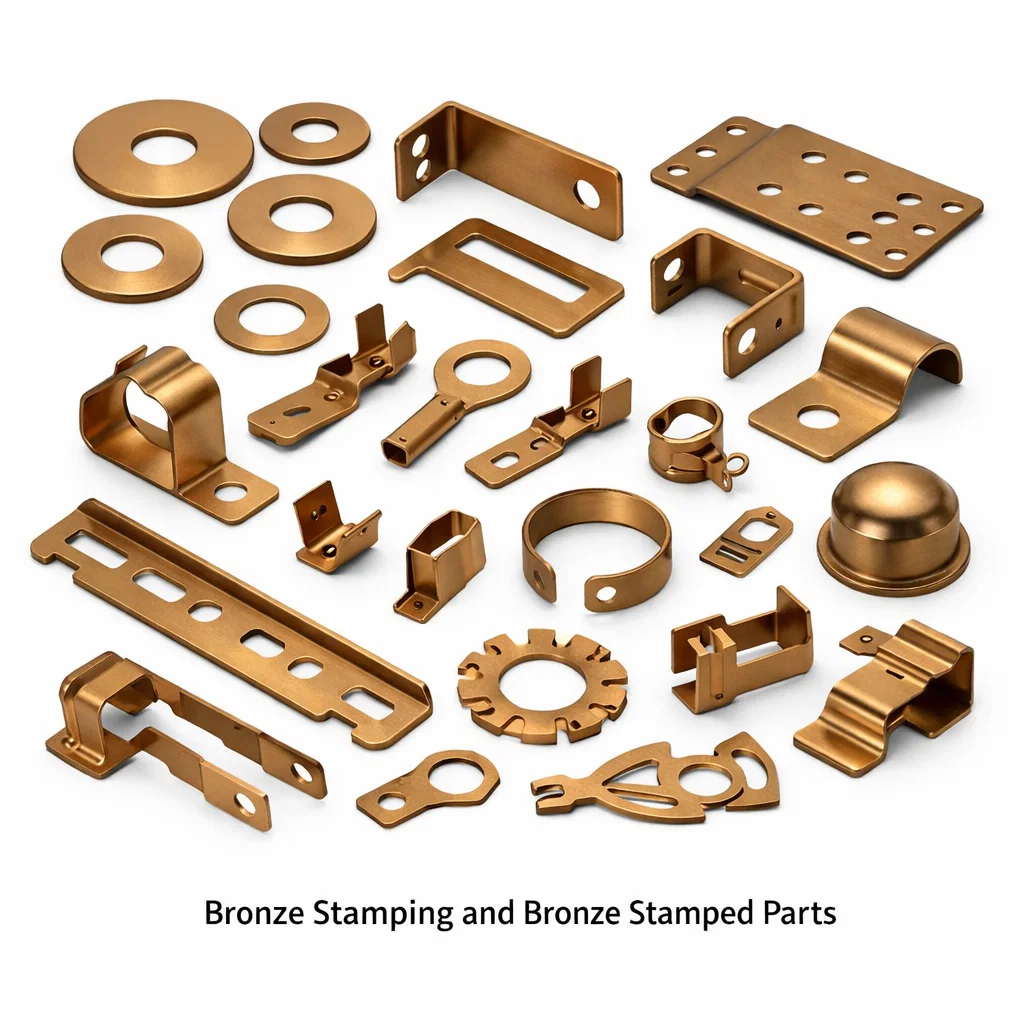
While aluminum bolted wedge connectors dominate overhead distribution on aluminum conductor systems, bronze bolted wedge connectors serve a critical and specialized role in copper conductor systems, substation applications, direct-burial connections, and mixed-metal installations where the superior corrosion resistance and conductivity of bronze provides measurable advantages over aluminum or steel alternatives. Understanding when and why bronze is the right material choice for bolted wedge connections can make the difference between a 20-year and a 50-year installation.
Why Bronze for Bolted Wedge Connectors?
Bronze (copper-tin alloy, often with additions of zinc, lead, aluminum, or silicon) offers a combination of properties uniquely suited to the most demanding electrical connector applications. Its electrical conductivity—typically 7–15% IACS depending on alloy—is sufficient for connectors used with copper conductors, where the connector cross-section is typically much larger than the conductor it joins. More importantly, bronze’s corrosion resistance in buried, submerged, coastal, and industrially polluted environments far exceeds that of aluminum alloys or galvanized steel. In substation ground mats, direct-burial copper feeder taps, and coastal overhead copper conductor systems, bronze bolted wedge connectors routinely outlast alternatives by decades.
Bronze vs. Aluminum Bolted Wedge Connectors: When to Choose Each
The choice between bronze and aluminum wedge connectors is primarily driven by conductor material and installation environment. Aluminum connectors on aluminum conductors in overhead service represent the most common scenario—lightweight, economical, and well-proven. Bronze connectors are the correct specification when copper conductors are involved, when the installation is buried or in contact with soil or water, when the environment has high chloride levels (coastal, industrial), or when the project specification requires UL 467-listed bronze grounding hardware. Bronze also provides better performance in indoor environments with ammonia or acid vapor exposure (agricultural buildings, chemical plants).
Types of Bronze Bolted Wedge Connectors
Single-Bolt Bronze Wedge Connectors
For smaller conductor sizes (through 4/0 AWG), single-bolt bronze wedge connectors provide an economical, compact tap connection for copper distribution conductors. These are commonly used in below-grade vaults, direct-burial secondary distribution networks in urban areas, and copper service drop installations in coastal regions where aluminum connectors are prone to corrosion.
Two-Bolt Bronze Wedge Connectors
For conductor sizes from 1/0 AWG through 500 kcmil, two-bolt bronze wedge connectors provide higher clamping force and dual-bolt redundancy. These are specified in utility substation grounding connections, medium-voltage underground feeder taps, and overhead copper conductor systems in corrosive coastal environments. The two-bolt design is also preferred in high-vibration industrial installations where single-bolt connections can loosen under sustained mechanical excitation.
Bronze Wedge Connectors for Substation Grounding
Substation ground mat connections involving bare copper conductors represent one of the primary markets for bronze bolted wedge connectors in North America. IEEE Std 80 recognizes bolted wedge connectors as an acceptable connection method for substation grounding systems when properly sized and listed. Bronze connectors provide the corrosion resistance and mechanical integrity required for the 40+ year design life of utility substation grounding systems.
Bronze Bi-Metal Wedge Connectors
For connecting copper conductors to aluminum conductors (or aluminum bus bars), bronze bi-metal wedge connectors with tin-plated channels provide a stable junction that minimizes galvanic corrosion at the copper-aluminum interface. These are found at the transitions from copper underground feeders to overhead aluminum distribution conductors, and at substation structures where copper ground conductors connect to aluminum electrical bus.
Related Products for Copper Conductor Systems
- Aluminum Bolted Wedge Connectors – For aluminum conductor systems and ACSR applications
- Bronze Ground Rod Clamps – For conductor-to-rod connections in substation grounding systems
- Bronze Ground Rod Couplers – For deep-drive electrode systems
- Copper Compression Splices – For inline splicing of bare copper grounding conductors
- Copper C Connectors – For smaller tap connections on copper service and feeder conductors
- Copper Compression Lugs – For terminating copper grounding and power conductors at equipment
Bronze Alloy Material Grades and International Equivalents
| Property | CDA 932 (SAE 660) | CDA 836 (LG2) | CDA 954 (Al-Bronze) | CDA 651 (Si-Bronze) |
|---|---|---|---|---|
| Copper % | 81–85 | 83–86 | 85–90 | 94–96 |
| Tin % | 6–8 | 4–6 | — | — |
| Lead % | 6–8 | 4–6 | — | — |
| Aluminum % | — | — | 8.5–11 | — |
| Silicon % | — | — | — | 2.8–3.8 |
| Zinc % | 2–4 | 4–6 | — | — |
| Elect. Conductivity %IACS | 12–14 | 13–15 | 7–9 | 7–9 |
| US Standard | ASTM B505/B584 | ASTM B584 | ASTM B148 | ASTM B99/B98 |
| BS Equivalent | BS 1400 LG2 | BS 1400 LG2 | BS 1400 AB1 | BS 2875 CA103 |
| ISO Equivalent | ISO 1338 CuSn7Pb7Zn3 | ISO 1338 CuSn5Pb5Zn5 | ISO 428 CuAl10Fe | ISO 427 CuSi3Mn |
| DIN Equivalent | DIN 1705 G-CuSn7ZnPb | DIN 1705 G-CuSn5ZnPb | DIN 1714 CuAl10Ni | DIN 17660 CuSi3Mn |
| JIS Equivalent | JIS H5111 CAC502 | JIS H5111 CAC502 | JIS H5111 CAC702 | JIS H3270 C6561 |
| Tensile Strength | 310 MPa | 280 MPa | 550 MPa | 380 MPa |
| Best Application | General buried connectors | Substations, direct burial | Marine, high-stress, coastal | Structural bolted connections |
Standards and Certifications
Bronze bolted wedge connectors for US electrical applications should comply with ANSI/IEEE C119.4 (overhead conductor connectors), UL 467 (grounding and bonding connectors for substation and grounding applications), and ASTM B584 or B505 for the casting alloy. For substation grounding applications, IEEE Std 80 provides the engineering basis for connector selection and sizing. ANSI/NFPA 780 covers lightning protection grounding connector requirements. RUS Bulletin 50-70 lists approved hardware for rural electric cooperative utility programs, which includes approved bronze connector designs.
Conductor Compatibility and Size Selection
| Connector Type | Run Conductor Range | Tap Conductor Range | Primary Application |
|---|---|---|---|
| Single-Bolt Bronze | #4 AWG – 4/0 AWG Cu | #6 AWG – 2/0 AWG Cu | Secondary distribution, ground mat taps |
| Two-Bolt Bronze | 1/0 – 500 kcmil Cu | #4 AWG – 4/0 AWG Cu | Substation feeder taps, underground distribution |
| Three-Bolt Bronze | 500 kcmil – 1000 kcmil Cu | 1/0 – 350 kcmil Cu | Large industrial, transmission copper systems |
| Bi-Metal Bronze | #4 AWG – 4/0 AWG Al | #6 AWG – 4/0 AWG Cu | Al-to-Cu transitions, substation bus connections |
Why Choose Us for Bronze Bolted Wedge Connectors
We manufacture bronze bolted wedge connectors from certified CDA 836 and CDA 932 alloy, using precision casting and machining processes to achieve the dimensional consistency and surface quality required for reliable long-term electrical performance. Our connectors are available with stainless steel 316 fasteners for maximum corrosion resistance, or with silicon bronze fasteners for all-bronze assemblies preferred in some utility specifications. We can supply connectors per customer drawings for utility standardization programs, or work from standard catalog sizes covering the full range from #6 AWG through 750 kcmil copper conductor combinations. Full material certification, dimensional inspection, and electrical resistance test data are available with every shipment. Our proven export program serves US utilities, EPC contractors, and electrical distributors with reliable delivery and technical support.
Frequently Asked Questions
Q1: Why use bronze instead of aluminum for substation ground mat connectors?
Substation ground mats use bare copper conductors buried directly in soil. Aluminum connectors in contact with copper conductors and buried in soil create a galvanic cell—aluminum is anodic to copper and will corrode rapidly in the presence of moisture. Bronze connectors are galvanically compatible with copper (similar electrode potential) and resist soil corrosion far better than aluminum. This is why IEEE Std 80-compliant substation designs specify copper or copper-alloy connectors for buried grounding hardware.
Q2: Can bronze wedge connectors be used with ACSR conductors?
Standard bronze wedge connectors are designed for copper (bare or tinned) conductors. ACSR is an aluminum conductor with a steel core—using a bronze connector on ACSR creates a galvanic junction between bronze and aluminum that is not recommended without a bi-metal design. For ACSR or AAC overhead conductors, aluminum connectors are the appropriate specification. Bronze is reserved for copper conductor applications.
Q3: What is the minimum burial depth for a bronze wedge connector in a substation ground mat?
IEEE Std 80 and local utility engineering standards typically require ground mat conductors to be buried at a minimum depth of 18–24 inches below finished grade. The bronze wedge connector must be capable of being buried at this depth without performance degradation—bronze handles indefinite burial depth without special treatment. In rocky or high-resistivity soils, deeper burial may be specified to reach lower-resistivity soil layers.
Q4: Are there thermal limits for bronze wedge connectors under fault current?
Bronze connectors can withstand temperatures up to 250–300°C for short-duration fault events without structural failure or loss of electrical integrity. The limiting factor in a fault current event is typically the conductor insulation (for insulated conductors) or the conductor softening temperature for copper. Bronze melts at approximately 950°C (compared to copper at 1085°C), so the connector will always outlast the conductor in a catastrophic fault event.
Q5: How do I prevent galvanic corrosion between bronze connectors and stainless steel bolts?
Bronze (copper-rich alloy) and stainless steel (iron-based) have a moderate galvanic potential difference. In outdoor or buried applications with moisture present, some corrosion at the interface is possible over decades of service. Using 316 stainless steel fasteners (rather than 304 or 18-8) minimizes this effect. Some specifications require silicon bronze bolts for all-copper-family assembly. Applying thread sealant or anti-galling compound to the fastener threads also helps by reducing electrolyte access to the interface.
Q6: Can I use bronze bolted wedge connectors for lightning protection grounding?
Yes. Bronze bolted wedge connectors are suitable for lightning protection grounding applications per ANSI/NFPA 780, provided they are listed for the application and sized for the down conductor diameter specified in the design. UL 467-listed bronze connectors are generally acceptable. The high peak currents (20–200 kA for lightning) that flow through lightning protection systems place greater mechanical stress on connectors than normal fault currents—use heavy-duty two-bolt designs for down conductor connections at ground level where the current pulse is concentrated.
Q7: What surface finish options are available for bronze bolted wedge connectors?
Bronze bolted wedge connectors are typically supplied in the as-cast or as-machined state, with the natural bronze surface providing adequate corrosion resistance for most applications. Optional surface treatments include electroless nickel plating (for very aggressive soil chemistry or seawater service), tin plating (for improved contact at the conductor interface, particularly for use with tinned copper conductors), and passivation. Bare bronze is sufficient for 95% of US utility and industrial grounding applications.
Q8: How do bronze bolted wedge connectors compare to exothermic welds for substation grounding?
Exothermic welds (cadweld-type) create a permanent molecular bond with resistance lower than the conductor itself and mechanical strength that cannot loosen over time. They are the preferred connection method where the highest reliability and permanent maintenance-free performance is required. Bronze bolted wedge connectors are acceptable per IEEE Std 80 and are used where field-removable connections are required (test points, future expansion provisions) or where the exothermic weld process is not practical (congested locations, flammable atmospheres). The choice between the two is typically made at the engineering design stage.
Q9: Are bronze bolted wedge connectors listed for use in Class I Division 1 hazardous locations?
The connector itself does not typically require a Class I, Division 1 listing—grounding connectors in hazardous locations are generally not considered ignition sources as they are part of the bonding system. However, the use of appropriate non-sparking tools during installation and the avoidance of connections that could generate arcing in normal service are required. Consult your project’s electrical classification drawings and the Authority Having Jurisdiction (AHJ) for specific requirements in hazardous location grounding installations.
Q10: What documentation do I need to submit to a utility inspector for bronze wedge connectors?
Most utility inspectors require the connector manufacturer’s datasheet showing the applicable listing (UL 467, IEEE C119.4, or equivalent), the conductor size range for which it is listed, and the installation torque specification. For utility capital projects, the engineer of record may additionally require material certification (MTR), compliance with the utility’s approved material list (AML), and in some cases, test reports from an accredited testing laboratory. We maintain all of these documents as part of our standard product file and can provide them with any shipment.
Q11: Can I use a bronze bolted wedge connector for bonding dissimilar metals in an industrial facility?
Bronze is an excellent choice for bonding connectors in industrial facilities where copper conductors must bond to stainless steel vessels, galvanized structural steel, or other metals. The bronze connector provides sufficient conductivity for fault current bonding purposes while its corrosion resistance protects the joint in the chemically challenging environments of pharmaceutical, food processing, petrochemical, and water treatment facilities. Check with your EPC engineer or facility electrical engineer for the specific requirements of your process environment.
Q12: What is the minimum order quantity for custom bronze bolted wedge connectors?
For standard catalog sizes, there is no minimum order quantity—we can supply from single pieces for evaluation through large project quantities. For custom designs (non-standard conductor combinations, special bolt patterns, proprietary channel geometries), minimum order quantities start at 100 pieces and vary with design complexity. Tooling and setup charges may apply for first-time custom orders. Contact us with your drawing or performance specification and we will provide a quotation with lead time and pricing for your specific requirement.